N.B. This article was originally written for the souvenir program of a concert by guest priests of the Diocese of Cubao, held in December 2007.
For we know that if the earthly tent which is our house is torn down, we have a building from God, a house not made with hands, eternal in the heavens. For indeed in this house we groan, longing to be clothed with our dwelling from heaven, inasmuch as we, having put it on, will not be found naked. For indeed while we are in this tent, we groan, being burdened, because we do not want to be unclothed but to be clothed, so that what is mortal will be swallowed up by life. Now He who prepared us for this very purpose is God, who gave to us the Spirit as a pledge. Therefore, being always of good courage, and knowing that while we are at home in the body we are absent from the Lord--for we walk by faith, not by sight (2 Cor 5:1-7).
Macintosh had for long expressed what people already knew by intuition and experience for far longer. In its revolutionary GUI (Graphic User Interface) technology of yore, now taken for granted by everyone all over the world, the once cryptic statement understandable only to the early generations of computer geeks of times past, has now become more than just a standard feature, but also almost a doctrine-like mantra that actually says more than it seems to suggest … WYSIWYG … What you see is what you get.
It turns out, on closer look, that more than just computer graphics is at stake here … “What you see is what you get” stands for more than just superficial representations of what is behind the shapes, sounds, colors, and shifting images that make up the actual cyber reality of our time and age.
What you see is what you get … I have it on the authority of cognitive therapists, especially schema therapists, that one’s vision shapes one’s reality. What one “sees” in the mind is starting point of what becomes, and what takes shape in the real world. An architect first has to “see” in his mind’s eye what eventually takes shape in a three-dimensional world of material reality. What one conjures up in the inner world of one’s thoughts, stands at the basis of what one tends to actualize and concretize in the external world marked by height, width, weight, and depth. What one convinces oneself of, tends to become some kind of a self-fulfilling prophecy, known once-upon-a-time as the “Rosenthal effect.” Schemata – the type of thoughts that fill our mind – are the very realities that we tend to live out. What one can “see” is something that most likely one can also somehow “do.” What you see is what you get.
But I read more in this almost prophetic statement of Apple.
I would like to suggest that it stands for more than just what our “new age” crazed world of infotainment seems to suggest. I would like to suggest, too, that something more than just the superficial “law of attraction,” popularized by the equally popular book entitled “The Secret,” is being referred to here.
What you see is what you get … No, I don’t speak of ions that build up in the atmosphere, and which, eventually form an energy mass that “attracts” the reality that one’s mind is trying hard to think about. No, I don’t speak of the so-called alignment of planets that follow the much-vaunted laws of the “age of aquarius,” that represents and constitutes favorable conditions for harmony and understanding to reign in the world.
I speak of better things here. I speak of a deeper vision … I speak of seeing not with so-called “soft eyes” made popular by The Celestine Prophecy of more than 15 years ago.
Bishop Anthony Bloom can help us here. He wrote many years ago that too many people live in only two dimensions in a world where there are actually three. People live like reality has to do only with the “here” and with the “now.”
People who behave like reality is only the here and the now, to use St. Paul’s terms, live only by sight. They see only what is palpable, quantifiable, and measurable.
To see only rottenness and sordidness in this world of corruption is to live by sight. To see only the rapid degradation of our society in every aspect is to live only in two dimensions. It means to see with “soft” uncritical eyes. It means seeing the “right things” but not necessarily “seeing rightly.” It means seeing, and being numbed by what one sees … being co-opted by what seems normal, legal, moral, and convenient, like as if all the said terms were on equal footing.
To live by sight alone is to see reality as flat, as drab, as lacking in depth, as lacking in perspective. It actually means to see less, not more.
The conditions of our times are rife for us all to see less and less. We see less of what is right, and more of what is personally and materially convenient. We see less of what is moral, and more of what is legal and advisable, and materially rewarding. We see less possibilities to aim for the better and the nobler, and more of opportunities and potentialities to work for the higher, the greater, and the more. We see less and less of God-at-work in history, and more and more of man intervening in history.
To live by sight alone is to see less, not more.
You have in your hands a kind invitation to see more, not less. The mere fact that you are reading this is proof enough that, deep inside, there is a very deep and very real longing in you to see the right things, and to see them rightly.
In our faith tradition and history, there was a man named Paul who saw the right things and saw them rightly. He saw pain staring him in the face. He saw and felt unalloyed joy at the sight of his beloved people in the various “churches” that he personally formed and evangelized. Paul saw suffering, shipwrecks, hunger, cold, heat, lashings, and gashing wounds of all kinds. He saw the love and dedication of his followers. But he also saw divisions, disunity, squabbles, and disharmony among the people he so dearly loved. He saw all the “right” and “real” things – enough to make anyone dejected and depressed.
But Paul saw more, not less. He had perspective. He had vision. And what he saw was what he got. He lived by faith, not by sight.
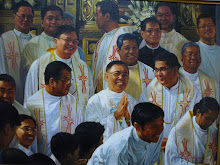
The men who made it possible for you to be reading this here and now, I would like to assure you, are men with a vision. Having journeyed with them in a humbling experience of reflecting together with them about faith, life, and priestly ministry last August 2007, I can vouch not only for their worthy dream, but also of their lofty vision that is not far different from Paul’s great vision.
They live in three dimensions. Thinking of the “here” and the “now,” they have planned and worked hard to regale you with songs that speak of their dreams – dreams that have to do with very real earthly concerns – the same concerns that you and I, as human beings, have – and ought to worry about in some way. But thinking, too, of the “hereafter,” their performance aims at bringing you closer towards another dimension that we all too easily tend to forget – the dimension of eternity. They are, after all, priests of the Roman Catholic Church, serving now the needs of the Diocese of Cubao. They have gathered here this evening, not only to regale you, but to sing with you the “songs of Zion,” to sing for you songs that remind us all that, indeed, we live in a world that opens to “what no eye has seen, nor ear heard, nor the heart of man imagined – what God has prepared for those who love him” (1 Cor 2:9).
There are times when we are tempted to do as the exiles in Babylon did … hang up our harps by the rivers and sit down and weep (cf. Psalm 137). Times there are, like now, when we’d rather see and focus solely on all the rottenness and the corruption around us, and then worry ourselves sick and wax angry at all that we see.
But these men that you have come to see perform tonight – in varying shapes, sizes, and ages – offer you an alternative vision. Allow them, I ask you, if only for a couple of hours, to remind you in less formal and less ecclesiastical circumstances, of the same old message that Paul spoke about two thousand years ago – that we are called to “live by faith, not by sight,” and that we are all called to “see more, not less.”
Showing posts with label Clergy Formation. Show all posts
Showing posts with label Clergy Formation. Show all posts
Wednesday, January 9, 2008

Wednesday, December 5, 2007
A LETTER OF LOVE ON MY 25th YEAR AS PRIEST
Casetta di Antonio Foundation, Inc.
Mailing Address: Unit 706 Herrera Tower, Valero corner Rufino Sts. Salcedo Village, Makati City 1227
Telephone Nos. 845-0876 *8958847
Telephone Nos. 845-0876 *8958847
Dear friend and benefactor,
I thank the good Lord who has allowed our paths to cross.
Over the past 25 years of my priesthood, He has so graciously favored me with the grace of having met and known so many people like you who support me, share my dreams, and actually help me realize them, or otherwise put faith and trust in whatever I say or do. Many have journeyed with me and worked with me in the vineyard of the Lord. A great many, who have since moved on and charted other pathways, helped me set up and keep afloat for almost 15 years now, the Cogliandro Memorial Foundation, now known as Bahaybusko Foundation. Still a greater number have been willing and cooperative recipients of – and collaborators in – my educational and formative ministry since I was ordained in 1982.
As I reach a major milestone in my priestly life this 25th year, I cannot but look back with gratitude to both God and individuals who have so graciously and generously allowed themselves to become instruments of His providential care on behalf of those whom Divine Providence has given to my direct and indirect charge. Of these 25 years, the many years spent in direct formation work for would-be priests and young priests take pride of place in my treasure house of memories. To be sure, trials and mistakes abounded. I look back to them now with a heart filled with a tinge of sadness, but never with regret. But I look back, too, to even more abounding instances of unparalleled joys and successes. They fill me with hope, and goad me on to dream some more in view of whatever is left of the time I still have on loan from the Creator.
As you have done in the past, I personally request you to please go on dreaming with me. Having been in direct formation work for would-be priests and young priests up till now, I have dreamed of setting up another foundation that would help make what I, and others, do, and what others also dream of doing with a semblance of solid and institutional grounding.
I ask you to support my cause by contributing in any way you can to the CASETTA DI ANTONIO FOUNDATION, INC. The dream has been percolating in my heart and mind for many years now, but I need help as it makes its first baby steps towards institutional realization. Lack of time and resources have prevented me from coming up with a formal brochure to give more details. For now, all I can tell you for sure is that, with my siblings’ go-signal, we have designated a portion of my late parents’ (Antonio & Remedios) very modest property as initial boost toward the realization of this dream.
I, therefore, personally knock at your door for help. Be an active contributing member of the CAFI and be part of the on-going formation of younger religious priests.
One with you and with my brother priests,
Fr, Chito Dimaranan, SDB
December 8, 2007
N.B. For my readers from North America, Australia, and Europe, you may send your donations care of J.D. De Leon, 27872 Pebble Court, Hayward, CA 94542-2502 USA. Please make checks payable to CASETTA DI ANTONIO FOUNDATION, INC. Readers from Asia & Australia may get in touch with us through the above Philippine mailing address, or you may want to wire your donations directly to Union Bank of the Philippines, Account # 202 02 0015303, Calamba, Laguna branch.
Subscribe to:
Comments (Atom)